

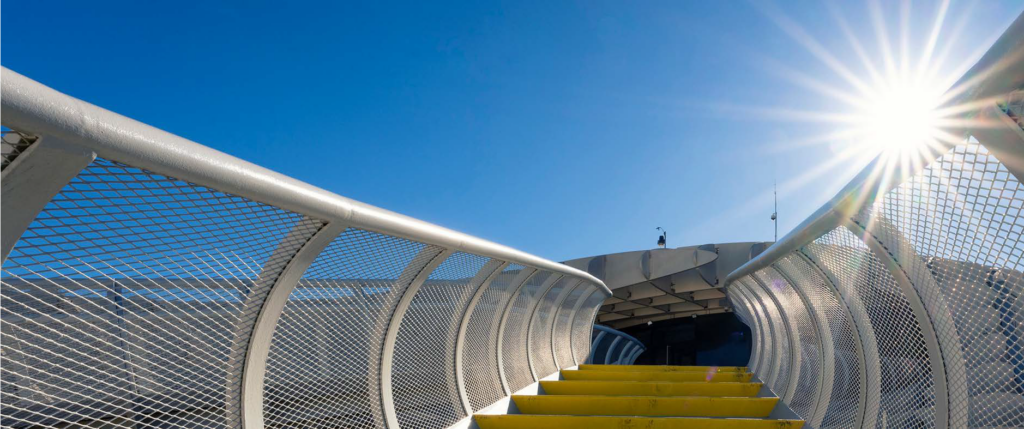
Stainless steel is widely chosen for cladding because of its durability, corrosion resistance, and striking aesthetic qualities. However, like all metals, stainless steel expands when heated and contracts when cooled. In façade design, these movements must be carefully managed to avoid deformation, noise, joint failure, and aesthetic distortion..
Austenitic grades such as 304 and 316, commonly used in façades, have a relatively high co-efficient of thermal expansion (CTE) of typically around 16.5 × 10⁻⁶ /°C. This is higher than carbon steel and closer to aluminium’s CTE, meaning stainless steel cladding can experience significant dimensional change.
According to metalarchitecture.com, metal panels can experience temperature swings of up to 38°C from ambient conditions due to solar heat gain, often much higher than the surrounding air. This magnifies the expansion effect. The implications of this includes stainless steel façade components expand more than many designers expect, especially in direct sunlight or when with dark-coloured finishes. With metals in general, cladding surfaces can exceed ambient temperatures substantially on hot days.
This effect must be included when estimating ΔT for expansion calculations. The design must take into consideration maximum solar surface temperature, not just local climatic air temperature.
Thermal movement requires proper joint and fixing design
Stainless steel panels must be installed with space for movement otherwise deformation, buckling, or “oil-canning” occurs.
Industry best practice include design principals such as:
- One fixed point per panel meaning that this point anchors the panel in position
- All other points should be designed as sliding or floating fixings. This can be done by slotted or oversized holes and sliding clips designed to allow longitudinal movement. This is the same principle used in bridge design: one end fixed, the other allowed to move freely.
This means that fasteners, brackets, and clip systems must be engineered to allow stainless steel to expand and contract without restraint. If stainless steel is prevented from moving freely, internal stresses accumulate until they release suddenly. This results in:
- Buckling or rippling of panels
- Permanent deformation
- Snapping, popping, or banging noises as panels release trapped movement.
- This is especially noticeable with large, flat stainless steel sheets because their reflective surfaces emphasize distortions.
Properly designed sliding joints and reduced friction at seams help prevent acoustic problems and visual defects. When stainless steel is mounted on aluminium or steel frames, each material expands at different rates.
Aluminium expands significantly more. Stainless steel cladding must never be rigidly fixed to dissimilar materials without movement allowance, since otherwise joints tear or distort.
Panel size, orientation and layout influence movement behaviour as mentioned earlier. Longer stainless steel panels undergo greater absolute expansion. This affects:
- Joint spacing and required gap width
- Maximum allowable panel length
- Placement of fixed points
- Orientation (vertical or horizontal movement direction)
For metals in general, expansion must be integrated into the cladding system geometry. This implies that large stainless steel panels often require custom detailing, segmenting, or patterned systems to distribute movement.
Welding distortion must be managed in stainless steel assemblies
Stainless steel, especially austenitic grades, have both higher thermal expansion and lower thermal conductivity compared to carbon steel. This causes greater distortion during welding. Pre planning, heat minimising welding procedures, efficient jigging, and strategic tack weld sequencing are crucial for quality products with flat, visually critical façade panels.
Since stainless steel is highly reflective, even minor panel deformation caused by thermal movement can be visually amplified. Azahner.com notes that thermal movement is a major factor in whether metal panels appear flat or buckle. Highly reflective finishes (e.g. mirror-polished stainless) demand especially careful detailing to maintain visual crispness.
Thermal expansion design rules for
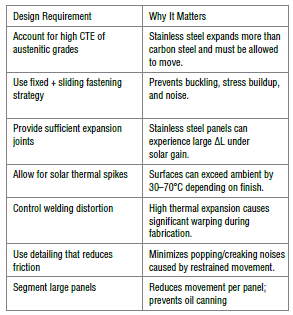
Stainless steel cladding
Stainless steel’s distinctive aesthetic appeal comes with a structural obligation that its high thermal expansion must be engineered into every façade system. Proper detailing of the movement of joints, sliding fixings, solar temperature planning, and welding control, ensures that stainless steel cladding remains flat, quiet, durable, and beautiful over decades of environmental exposure.