

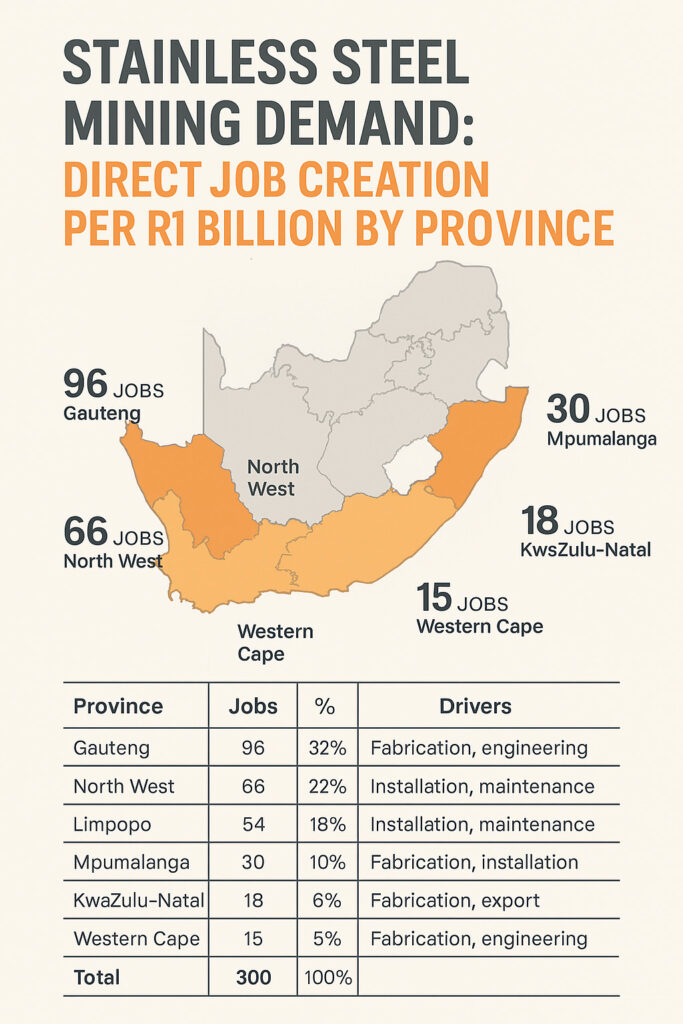
 As South Africa’s mining sector increasingly adopts stainless steel solutions to address corrosion, abrasion, safety, and lifecycle performance challenges, a broader economic opportunity is emerging alongside material demand. Beyond the stainless steel itself, mining applications are creating employment opportunities across fabrication, installation, maintenance, engineering, and specialist technical services. Industry stakeholders believe the real long-term value lies not only in materials supply, but in developing a skilled local manufacturing and engineering ecosystem capable of supporting both domestic mining projects and export markets.
South Africa’s mining industry has long been recognised as one of the country’s largest industrial employers. Increasingly, however, the growing use of stainless steel within mining applications is creating opportunities far beyond raw material production itself.
The greatest employment impact linked to stainless steel demand does not occur at primary steelmaking level.
Instead, jobs are created throughout the downstream value chain in fabrication, welding, modular assembly, installation, inspection, maintenance, and specialist engineering services.
As mining companies continue to invest in corrosion resistant and long-life infrastructure, demand for stainless steel fabrication is expanding alongside the need for skilled technical labour.
Process Plants Deliver the Highest Job Multiplier
Mining process plants within the platinum group metals (PGMs), gold, chrome, and coal sectors currently represent the strongest source of stainless steel-related employment opportunities.
Typical stainless steel applications include:
- Tanks and thickeners
- Flotation cells
- Slurry pipelines and fittings
- Pump skids and modular systems
- Tailings and water-treatment infrastructure
These projects require a wide range of skilled and semi-skilled labour, creating strong localisation potential for South African industry.
Key employment categories include:
- Welders and boilermakers
- Pipe welders and pipe fitters
- Welding inspectors and NDT technicians
- Mechanical and metallurgical engineers
- Production planners and QA personnel
- Installation crews and site supervisors
Since many mining systems are customised for specific operations, local fabrication capability becomes highly valuable.
Modular Fabrication Supporting Stable Industrial Employment
Another important growth area is the fabrication of pumps, pipelines, and modular stainless steel skids. Mining companies increasingly prefer pre-fabricated systems that can be assembled off-site and installed rapidly at remote operations. This shift toward modularisation is creating repeatable, scalable manufacturing work within factory environments.
Products driving demand include:
- Duplex and 316 stainless steel piping
- Pump casings and impellers
- Modular pump stations
- Process skids and pipe spooling systems
Skills increasingly required:
- Precision welders
- CNC machinists and operators
- Pipe spooling technicians
- Modular assembly teams
- Commissioning specialists
Unlike some mining-related work that fluctuates according to commodity cycles, modular fabrication offers the potential for more stable industrial employment while also supporting export-oriented production.
Underground Infrastructure Creates Long-Term Demand
In deep-level gold and PGM mining operations, stainless steel demand is also linked closely to safety-critical underground infrastructure.
Common applications include:
- Handrails and walkways
- Ladders and access systems
- Cooling-water and service-water piping
- Dewatering infrastructure
These systems require ongoing installation, maintenance, refurbishment, and replacement work over the lifespan of a mine.
Typical employment opportunities include:
- Underground fitters and artisans
- Installation crews
- Maintenance technicians
- Shaft infrastructure specialists
Because underground mining infrastructure must comply with stringent safety standards, stainless steel solutions often support long-term maintenance-driven employment rather than short-term project work alone.
Specialist Skills Needed for Wear-Corrosion Applications
Mining sectors such as manganese, chrome, and iron ore create demand for specialist stainless steel fabrication in highly abrasive environments.
Typical applications:
- Chutes and liners
- Screens and transfer systems
- Wet-area processing components
- Retrofit wear solutions
Although these sectors may not generate the same employment volumes as process plants, they require highly specialised technical skills.
Niche skills include:
- Specialist welders
- Hard-facing technicians
- Retrofit teams
- Maintenance planners
These applications reinforce the importance of developing advanced stainless steel fabrication expertise within the local market.
Skills Development Remains Critical
Industry stakeholders continue to highlight the importance of retaining and developing stainless steel related skills within South Africa.
Entry-level and artisan pathways include:
- TVET training and apprenticeships
- Stainless steel welding certification
- Pipe fitting and modular assembly training
- Site installation experience
At mid-level technical level, shortages remain a concern in areas such as:
- Welding inspection
- Non-destructive testing (NDT)
- QA/QC management
- Production planning
Higher-level technical skills are equally important in supporting export competitiveness and engineering leadership.
Strategic high-level skills include:
- Welding engineers
- Metallurgists
- Design engineers
- EPC project managers
These roles are particularly important in duplex stainless steel applications, modular plant design, and lifecycle cost optimisation.
Addressing Strategic Skills Gaps
Several strategic challenges remain within the industry. One of the most significant is the shortage of certified stainless steel and duplex welders. Industry observers frequently reference failures experienced in large infrastructure projects such as Medupi as examples of the high cost associated with inadequate welding capability.
Beyond Materials: Building an Industrial Ecosystem
Industry participants increasingly argue that stainless steel demand in mining should not be viewed purely as a materials issue.
Instead, it represents an opportunity to expand fabrication capacity, create skilled employment, strengthen industrial capability, and develop export-ready engineering services.
As mining companies continue to prioritise reliability, corrosion resistance, and lifecycle performance, stainless steel applications may become an increasingly important driver of South Africa’s broader industrial and skills development strategy.