

Stainless Steel: Supporting SA Mining Where Performance Matters Most
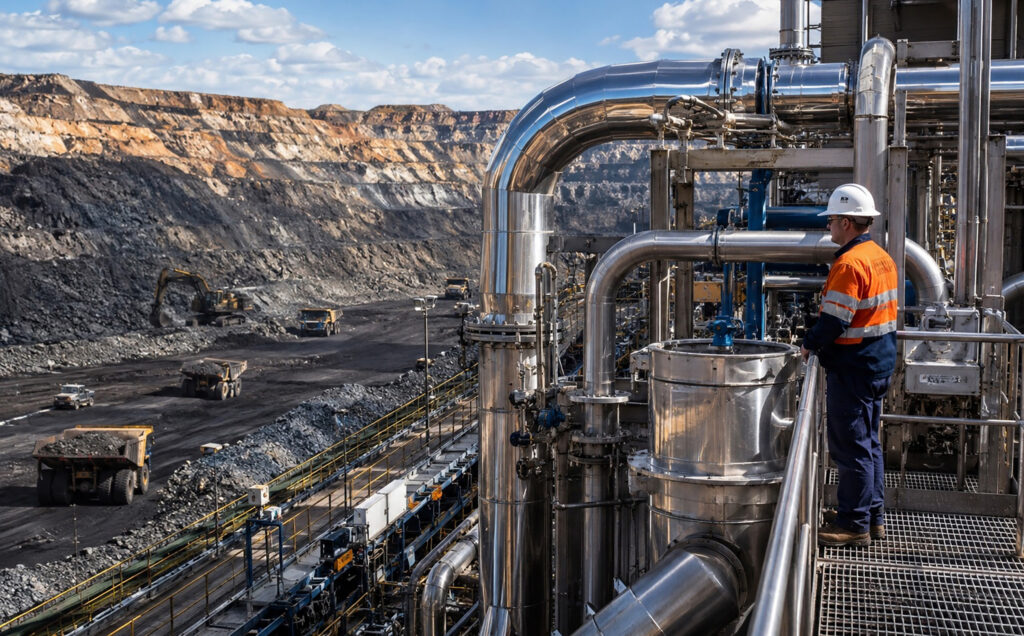
From deep-level gold shafts to mineral processing plants handling aggressive slurries and acidic water, stainless steel has become a critical material in South Africa’s mining industry. While carbon steel continues to dominate large structural applications, stainless steel is increasingly being specified where corrosion resistance, durability, safety, and lifecycle performance matter most. As mining companies face rising maintenance costs, environmental pressures, and the need for operational reliability, stainless steel is proving its value across the mining value chain…
South Africa’s mining sector remains one of the country’s most important economic drivers, operating in some of the harshest industrial conditions in the world. From deep-level gold and platinum mines to large-scale chrome, manganese, and iron ore operations, the industry demands materials capable of withstanding corrosion, abrasion, moisture, chemicals, and continuous heavy-duty operation.
Within this environment, stainless steel has become an essential enabling material. Its role is not to replace carbon steel entirely, but rather to provide targeted performance advantages in applications where failure, downtime, or contamination carry significant operational and financial consequences.
Mining conditions in South Africa are particularly demanding. Acid mine drainage, chloride-rich water, chemically aggressive slurries, and high underground humidity all contribute to accelerated material degradation. At the same time, many operations are located in remote areas where maintenance shutdowns can be extremely costly.
Under these conditions, stainless steel offers several important advantages, including corrosion resistance, improved abrasion performance, lower maintenance requirements, and extended service life. Although the initial material cost may be higher than conventional carbon steel, the long-term lifecycle savings often justify the investment.
Corrosive capability
One of the largest areas of stainless steel use in mining is within mineral processing plants. These facilities operate continuously and handle highly abrasive and corrosive slurries that rapidly damage conventional materials.
Stainless steel is commonly used in slurry pipelines, pumps, impellers, flotation cells, screens, cyclones, filters, and reagent tanks. In these applications, material reliability directly affects production continuity and maintenance schedules.
Several stainless steel grades are widely used in South African mining applications. Austenitic grades such as 304 and 304L are typically specified for general corrosion resistance, while 316 and 316L offer improved resistance in chloride-rich and acidic environments. Duplex stainless steels such as 2205 provide higher strength and enhanced corrosion resistance for more aggressive duties.
South Africa has also played an important role in the development and adoption of utility ferritic stainless steels, particularly 3CR12. Originally developed locally for demanding industrial environments, 3CR12 has become widely used in mining applications where moderate corrosion resistance and cost efficiency are required.
Underground mining infrastructure represents another significant area of stainless steel use. In deep-level operations, where safety and reliability are critical, stainless steel is frequently specified for service water piping, compressed air systems, cooling infrastructure, dewatering systems, handrails, gratings, cable trays, and ventilation components.
Corrosion-related failures underground can create serious operational and safety risks. Stainless steel helps reduce these risks while also lowering maintenance demands over the life of the mine.
A variety of applications
Water management remains a particularly important challenge for South African mines. Dewatering systems often operate continuously in acidic and abrasive environments, placing severe strain on pumps, valves, and pipelines. Stainless steel, especially 316 and duplex grades, is increasingly used in pump internals, valve bodies, and dewatering pipelines to improve operational reliability and reduce downtime.
In materials handling applications, stainless steel is used more selectively. While carbon steel continues to dominate major structures, grades such as 3CR12 are commonly used in ore chutes, transfer points, hopper liners, and screens where abrasion and corrosion occur simultaneously. Certain stainless steels also exhibit work-hardening properties under impact, improving wear performance over time.
Environmental compliance is another growing driver of stainless steel use. Tailings systems, water treatment plants, acid neutralisation infrastructure, and remediation projects all require long-term resistance to corrosion and leakage risks. Stainless steel’s durability makes it well suited for these applications, particularly where infrastructure is expected to operate reliably for decades.
As mining companies increasingly evaluate materials on total lifecycle cost rather than upfront purchase price alone, stainless steel continues to strengthen its position within the sector. Beyond operational performance, the material also supports local fabrication capability, maintenance industries, and South Africa’s broader stainless steel value chain.
For the mining industry, stainless steel is no longer viewed simply as a premium material choice. In many critical applications, it has become an operational necessity.