

Rebuilding Local Strength: How Stainless Steel Localisation Could Reshape South African Manufacturing
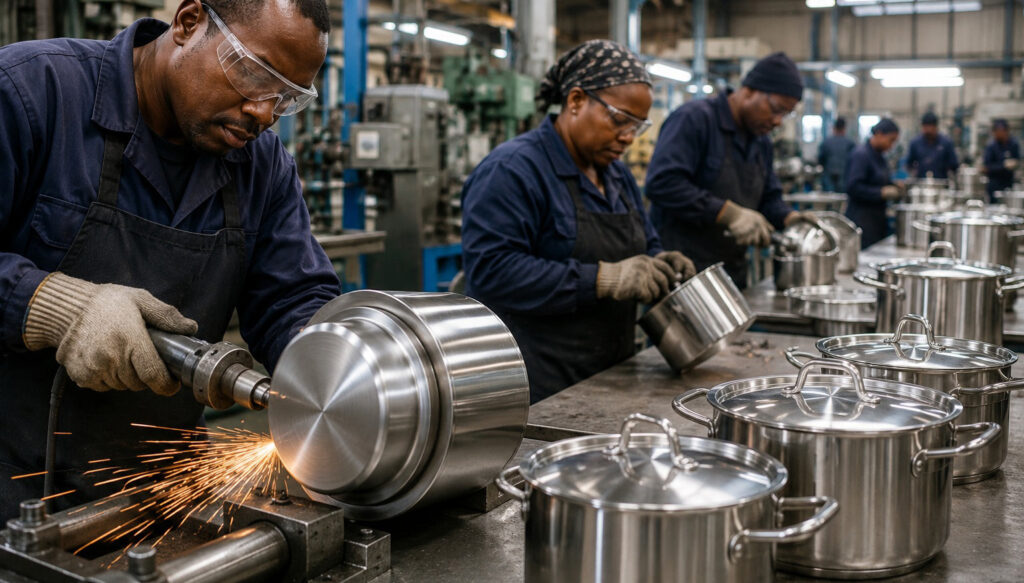
For South Africa’s stainless steel industry, localisation is no longer simply a policy discussion or a theoretical economic ambition. Increasingly, it is becoming a practical industrial strategy focused on rebuilding manufacturing capability, creating jobs, strengthening supply chains and positioning local companies more competitively within global markets.
Across several sectors, including hollowware, packaging equipment, food processing technology and specialised industrial components, new opportunities are emerging to bring manufacturing activity back onto South African soil using local stainless steel, local skills and local manufacturing expertise.
For Sassda, these developments form part of a broader strategic drive to strengthen the long-term sustainability of South Africa’s stainless steel value chain while unlocking new industrial growth opportunities.
Localisation Momentum
At the beginning of 2026, Sassda embarked on a focused localisation strategy aimed at steering the industry towards improved manufacturing competitiveness and stronger export participation.
The strategy is built around a relatively simple but increasingly important principle: South Africa possesses significant manufacturing skill, technical expertise and stainless steel processing capability, but far more value can still be unlocked by localising products and components that are currently imported into the country.
At the same time, global supply chains are changing.
International original equipment manufacturers (OEMs) are increasingly looking for regional manufacturing partners capable of reducing logistics costs, shortening supply chains and improving responsiveness to African and Southern Hemisphere markets.
This creates a unique opportunity for South Africa’s stainless steel sector.
A recent example involved a European OEM seeking local manufacturing partners capable of producing specialised stainless steel components for packaging equipment. The objective was to reduce the cost and complexity associated with transporting European-manufactured components and spare parts into African markets.
Sassda facilitated discussions between the OEM and local member companies with the required capabilities, with the engagement reportedly progressing positively into supplier vetting processes.
Beyond the immediate project itself, the initiative highlights the growing role South Africa can potentially play as a regional manufacturing and support base for international companies.
Manufacturing Revival
Perhaps one of the strongest examples of localisation potential currently under discussion lies within the hollowware and catering products sector.
South Africa was once a significant producer of stainless steel hollowware products, including pots, pans and catering equipment. However, over the past two decades, the sector has experienced severe decline under pressure from low-cost imported products, particularly from China.
According to industry estimates, between 15 000 t and 20 000 t of catering and hollowware products are imported into South Africa annually, with China accounting for more than 96% of total imports.
For Sassda, the concern extends beyond import volumes alone. The hollowware industry historically represented an important area of local stainless steel value addition, manufacturing activity and employment creation. Its decline has contributed to significant de-industrialisation within the sector.
At the same time, global changes within the automotive industry are creating unexpected new opportunities.
As the global shift towards electric vehicles places pressure on traditional automotive component manufacturers involved in exhaust systems and catalytic converters, several South African automotive suppliers are now exploring diversification into other manufacturing sectors that can utilise their advanced presswork technologies and production capabilities.
Sassda is currently working with major automotive component manufacturers to investigate whether this world-class automotive manufacturing expertise can be applied to local stainless steel hollowware production.
The opportunity could be substantial. Industry estimates suggest that successfully rebuilding even part of the local hollowware sector could potentially localise up to 20 000 t of stainless steel consumption annually while creating significant employment opportunities across skilled, semi-skilled and lower-skilled labour categories.
Importantly, hollowware manufacturing is also viewed as particularly labour intensive and capable of supporting large-scale job creation. Sassda estimates that reclaiming even half of the current market could potentially create more than 30 000 sustainable jobs.
Skills And Scale
One of the key themes emerging across these localisation initiatives is the importance of technical capability and manufacturing expertise.
South Africa’s stainless steel sector continues to possess highly skilled fabricators, welders, manufacturers and technical specialists capable of producing sophisticated industrial products and components.
In another localisation initiative, Sassda assisted in facilitating the potential local manufacture of specialised food processing components linked to technology originally developed in South Africa before later being acquired by international companies.
Although the equipment had continued to be manufactured overseas, much of the technical knowledge and support infrastructure remained rooted locally.
One of the primary challenges involved material specifications requiring stainless steel grades not readily available within South Africa. Sassda provided technical support to adapt these specifications to locally available stainless steel materials, opening the door for local production opportunities.
The initiative also demonstrated the growing role advanced stainless steel grades can play in sectors such as food processing, packaging equipment and specialised industrial applications where corrosion resistance, hygiene and durability are critical.
Importantly, localisation does not only benefit manufacturers themselves. When components, products or systems are manufactured locally, the economic impact extends throughout the broader stainless steel value chain, including material suppliers, welding consumable suppliers, abrasives suppliers, logistics providers and technical service companies.
It also exposes local companies to international standards, new technologies and export-focused manufacturing disciplines.
Competitive Pressures
While the opportunities are significant, the challenges remain equally real.
Sassda continues to express concern around anti-competitive import pressures and unfair customs values associated with certain imported stainless steel products.
Analysis of recent import data indicates that hollowware imports from China entered South Africa during 2024 and 2025 at customs values averaging approximately R22/kg, compared with approximately R103/kg for imports from India.
When compared against the base material costs associated with common stainless steel grades such as 430, 304 and 316, the pricing disparities raise serious concerns regarding fair competition within the local market.
While Sassda does not support blanket tariffs across all stainless steel imports, the organisation believes stronger enforcement against anti-competitive practices remains essential to protecting local manufacturing capability.
At the same time, support mechanisms such as the Localisation Support Fund, engagement with the International Trade Administration Commission of South Africa (ITAC) and strategic cooperation with government and retailers are viewed as increasingly important components in rebuilding industrial capacity.
Retailer participation is expected to play a particularly important role within the hollowware sector, where large retail procurement decisions could significantly influence the viability of local production.
Building Forward
For Sassda, the broader significance of localisation extends well beyond import replacement alone.
The organisation sees localisation as an opportunity to rebuild manufacturing confidence, stimulate industrial investment and strengthen South Africa’s role within global manufacturing supply chains.
In many respects, the current moment represents an important strategic crossroads for the stainless steel industry.
Global supply chains are being reassessed. International manufacturers are seeking more agile regional production partners. Industrial resilience is becoming increasingly important. At the same time, South Africa retains many of the technical capabilities, manufacturing skills and industrial infrastructure required to participate meaningfully in these shifts.
The challenge now lies in translating that potential into sustained industrial growth.
If successful, localisation within the stainless steel sector could ultimately help drive increased local stainless steel consumption, stronger manufacturing capability, export growth and large-scale employment creation while reinforcing South Africa’s reputation for technical manufacturing excellence.