

Passive Layer, Active Risk: Why Coastal Stainless Steel Failures Start in the Workshop
South Africa’s coastline remains one of the harshest environments in the world for stainless steel applications, yet industry experts argue that most failures blamed on material selection are, in fact, rooted in poor fabrication practices. Sassda has just launched a new technical guide on stainless steel passivity in South African coastal environments which urges engineers, fabricators and specifiers to rethink the way corrosion risk is assessed and managed.
At the centre of the discussion is the passive layer, the ultra-thin chromium-rich oxide film that gives stainless steel its corrosion resistance. While the alloy itself may contain as much as 70% to 80% iron, it is this microscopic passive layer that prevents corrosion by blocking metal dissolution and continuously reforming in the presence of oxygen.
However, in coastal South African conditions, maintaining that passive layer is far more difficult than many project teams appreciate.
The combination of high chloride exposure, strong prevailing winds, warm temperatures and daily wet-dry cycles creates an aggressive environment where even small fabrication defects can rapidly develop into visible corrosion. According to the guide, these conditions expose “fabrication sins” within months rather than years.
This has significant implications for commonly specified grades such as 304 and 316 stainless steel. Grade 304, which lacks molybdenum, has limited resistance to chloride attack and is generally regarded as unsuitable for coastal applications close to the sea.
Grade 316 performs considerably better due to the presence of molybdenum, which improves pitting resistance and supports re-passivation of damaged areas. Yet the guide stresses that 316’s coastal performance is highly dependent on fabrication quality. Correctly fabricated components can provide excellent service life, while poorly fabricated systems may fail rapidly and visibly.
Duplex stainless steels offer the highest level of corrosion resistance owing to their elevated chromium, molybdenum and nitrogen content. Nitrogen, in particular, significantly improves re-passivation kinetics and localised corrosion resistance. Nevertheless, the report cautions that even duplex grades are not immune to poor workmanship.
Fabrication flaws
The guide identifies fabrication-induced corrosion as the dominant cause of premature stainless steel failures along the South African coast. Among the most common problems are heat tint left after welding, inadequate pickling and passivation, carbon steel contamination, rough grinding and the creation of crevices during fabrication or installation.
Heat tint, for example, creates chromium-depleted zones with weakened corrosion resistance. If not properly removed, these areas can become initiation points for pitting and crevice corrosion. Likewise, carbon steel contamination from shared workshop tools or grinding dust can establish local corrosion cells that attack the stainless steel surface.
The report argues that many corrosion failures incorrectly attributed to material grade selection are actually workmanship-related. A key diagnostic indicator is corrosion patterning. Corrosion concentrated around welds, fasteners or isolated surface areas generally points to fabrication or contamination issues rather than alloy inadequacy. Uniform pitting across all surfaces is more indicative of a genuine material-environment mismatch.
To address these risks, the guide proposes a strict fabrication checklist for coastal applications. Recommended controls include dedicated stainless steel-only tooling, controlled welding procedures, complete heat tint removal, mandatory pickling and passivation, smooth low-roughness surface finishes and rigorous final cleaning before handover.
Common problems
The guide also highlights recurring problems in common coastal applications.
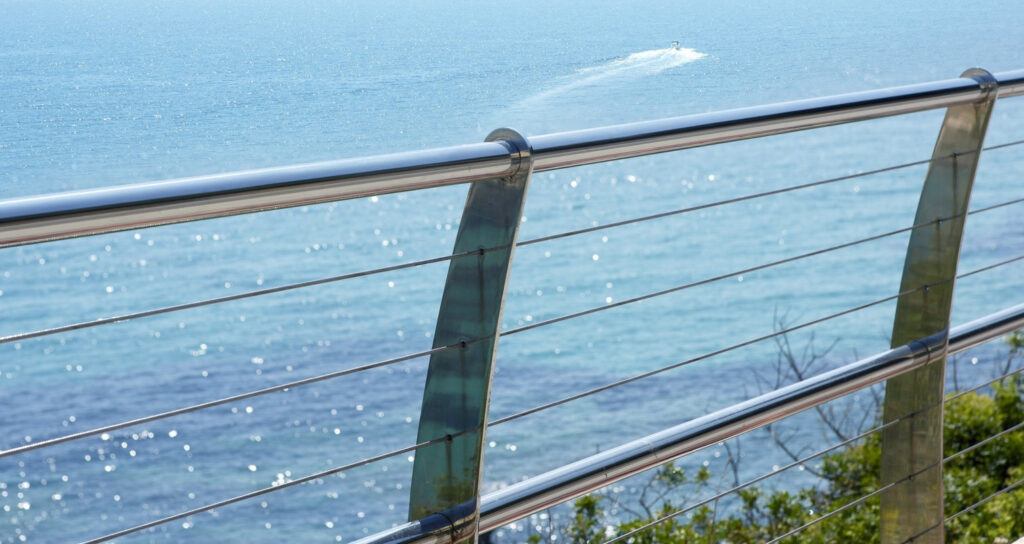
Architectural balustrades often experience rust bleeding from welds and tea staining on horizontal rails due to inadequate weld finishing and poor drainage design. Tanks frequently suffer pitting along weld seams or shell-to-floor junctions where poor surface preparation and insufficient cleaning allow chlorides to concentrate. Fasteners are especially vulnerable when incorrect materials or contaminated components are used, while piping systems commonly fail at heat-affected weld zones or dead-leg sections where oxygen depletion occurs.
Material selection remains important, but the report stresses that fabrication quality ultimately determines performance. For applications within 500 m of the coast, duplex stainless steels are strongly preferred, while 316 may still be acceptable under carefully controlled fabrication conditions. Grade 304 is generally considered unsuitable in these zones.
Further inland, exposure severity decreases, allowing broader use of 316 and, in some cases, 304. However, the report warns that poor fabrication practices can undermine the performance of any alloy grade regardless of theoretical corrosion resistance.
The publication concludes that the stainless steel industry must shift its focus away from simply upgrading alloys whenever corrosion appears. While specifying more noble and expensive materials may sometimes mask underlying problems, it does not necessarily solve them.
Instead, the report argues that South Africa’s coastal corrosion challenge should be approached through disciplined fabrication, proper surface treatment and a deeper understanding of passive layer behaviour.
In practical terms, the message to the industry is clear: stainless steel success on the South African coast depends less on what alloy is selected and more on how that alloy is handled before it reaches service.