

The Silent Clock Inside Concrete
Why the Morandi Bridge Disaster Demands a Material Revolution
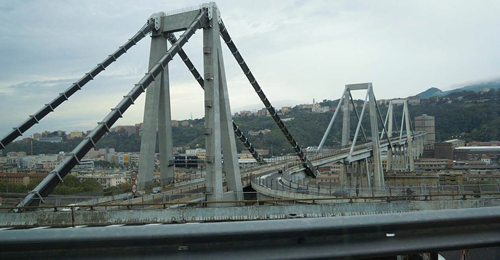
On the morning of 14 August 2018, a 210-metre section of Genoa’s Ponte Morandi Motorway Bridge collapsed into the Polcevera river valley. Thirty vehicles fell about 45 metres; 43 people died. The disaster severed a major transport link and prompted a lengthy criminal investigation. For engineers, asset managers and policymakers, the collapse remains a stark reminder of the risks that can accumulate inside ageing infrastructure, out of sight..
When the bridge opened in 1967, it was hailed as an engineering achievement. Designed by Riccardo Morandi, it used an unusual cable-stayed system. Rather than leaving the steel cable bundles exposed, the design encased prestressing tendons in concrete sheaths. Concrete’s naturally alkaline environment can help protect embedded steel by forming a passive layer on its surface.
The approach, however, made inspection of the tendons difficult and left the structure dependent on a small number of key stays. These features became central to later debate about the bridge’s condition, maintenance and design.
The Morandi collapse should not be reduced to a single material choice or cause; investigations examined a complex combination of design, deterioration, monitoring and maintenance.
The bridge stood less than a kilometer from the Mediterranean. Over time, moisture and chlorides can penetrate concrete through pores and cracks. If they reach carbon steel reinforcement, they can disrupt its protective passive layer and initiate corrosion, including localised pitting. Corrosion can reduce the steel’s effective crosssection and compromise its performance. Where steel is concealed inside concrete, detecting deterioration early can
be challenging.
The real cost of “cheap” infrastructure
Carbon steel remains the default reinforcement choice in many projects, in part because its initial material cost is lower. In coastal areas, structures exposed to de-icing salts and other aggressive environments, however, the purchase price is only one part of the calculation. Maintenance, repair, access and disruption over a structure’s life also carry significant costs.
To illustrate the difference, the Sassda life-cycle cost calculator was used to model a hypothetical 100-year infrastructure project requiring 100 tonnes of reinforcement The example applies a 3% public-sector discount rate to future maintenance costs. Its results depend on the assumptions used, but they show how repair costs can change the comparison over time.
What the model shows
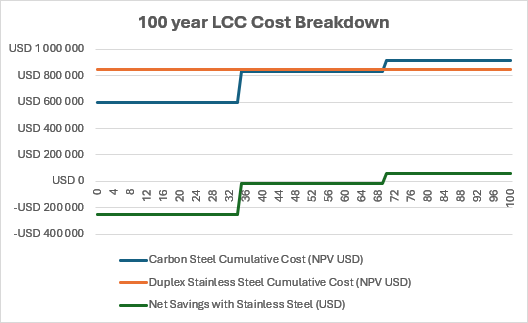
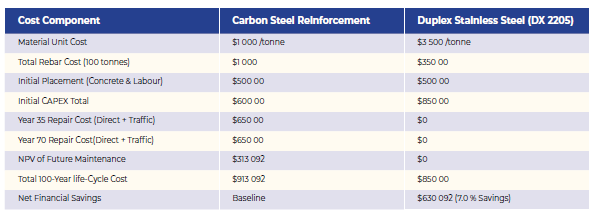
The example assumes duplex stainless steel, such as Grade 2205, at $3 500 per tonne, compared with $1 000 per tonne for carbon steel. The stainless steel option carries a higher initial material cost. Once labour, civil works and concrete are included, the model puts the difference in total project cost at $250 000: $850 000 for the stainless steel option against $600,000 for carbon steel.
In the model, a major carbon steel repair in year 35 costs $650 000. Discounted to present value, that repair is $230 999. At that point, the lower initial cost of the carbon steel option has been overtaken by the cost of repair. A second repair cycle in year 70 brings the modelled 100-year cost of the carbon steel structure to $913 092.
The stainless steel option is modelled with no structural maintenance over the same period, leaving its cost at $850 000. On these assumptions, the difference is $63 092, or about 7%, in favour of stainless steel. The calculation does not include wider costs such as traffic delays, lane closures or the consequences of premature structural failure. These should be considered alongside direct repair costs when decisions are made.
Designing for the next century
The wider lesson is not that one material suits every project. It is that material selection should reflect the exposure conditions, design life and consequences of failure. In high corrosion environments, stainless steel reinforcement can reduce the risk of corrosion-related deterioration and the
need for disruptive repairs.
Sassda advocates for three changes in the way public infrastructure is planned and procured:
- Specify stainless steel where exposure warrants it. In coastal locations and areas exposed to de-icing salts or other severe corrosion risks, stainless steel reinforcement should be assessed for the most vulnerable parts of the structure.
- Use life-cycle costing in procurement. Project bids should be evaluated against realistic maintenance and repair costs over the intended service life, alongside the initial construction price.
- Reduce risks that cannot be seen. Reinforcement and other critical components embedded in concrete should be selected with their exposure, inspectability and long-term performance in mind
Ponte Morandi’s collapse had multiple causes, and no single material change can guarantee that a structure will be safe. But the disaster underlines the consequences of allowing deterioration to remain hidden and of judging infrastructure by its initial cost alone. Choosing durable materials, supported by sound design, inspection and maintenance, is an investment in safer, longer-lasting public infrastructure.