

Precision by Design: Unlocking the Full Potential of Laser Welding
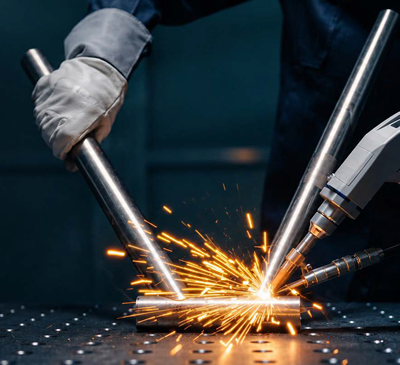
Laser welding has changed the way stainless steel sheet metal components are designed and manufactured. Once largely confined to specialised industries such as aerospace and automotive manufacturing; modern fibre laser technology is now accessible to fabricators producing everything from electrical enclosures and food-processing equipment to pharmaceutical systems, architectural fabrications and industrial products.
The difference between laser welding and conventional joining methods is not simply speed. It calls for a different design philosophy.
Products must be developed with precision, repeatability and manufacturability in mind, rather than relying on the fabrication shop to compensate for design shortcomings.
Traditional TIG and MIG fabrication methods have often allowed fit-up inaccuracies, dimensional variation and complex assemblies to be corrected through operator skill and filler metal. Laser welding, by contrast, rewards accurate design and disciplined manufacturing. Its narrow weld profile, low heat input and small molten pool leave less tolerance for poor fit-up or inconsistent assembly conditions. Good design is therefore central to a successful weld.
Designing for Precision and Repeatability
The first principle of laser-welding design is precision. Laser welds are typically narrow and often autogenous, making the process sensitive to variations in joint gap and component alignment. Components should fit together accurately and consistently, without excessive manipulation, shimming or rework during assembly.
Consistency matters just as much. A manufacturing process can accommodate minor dimensional variation when it is predictable. Problems arise when geometry, material thickness, joint gaps or assembly conditions vary from one component to the next. Designs for laser welding should minimise unnecessary complexity and favour repeatable geometries that support stable manufacturing conditions.
Repeatable components improve weld quality and make automation easier. Many of the benefits of laser welding are realised when it is combined with robotic systems, automated assembly and digital manufacturing technologies. Consistent part geometry allows welding parameters to remain stable, improving productivity and reducing quality variation.
Effective Simplicity
A component may be technically manufacturable and still be unnecessarily costly or difficult to produce. Designers should assess each feature in terms of its contribution to the finished product. Successful laser-welded components generally have simple geometries, clear welding access and efficient assembly methods. Features that add complexity without a functional benefit should be reconsidered.
An effective strategy is to incorporate self-locating features into the sheet metal geometry. Laser-cut tabs and slots, locating shoulders and folded positioning features can establish alignment during assembly. These features reduce reliance on operator skill, improve dimensional consistency and limit fixture complexity. When components can fit together in only one correct position, assembly is faster, more accurate and better suited to automation.
Designers should also consider how the laser welding head will reach the joint. A well-designed joint is of little use if the welding head, optics or shielding gas system cannot access it effectively. Deep recesses, narrow channels and obstructed corners should be avoided or redesigned to provide clear beam access. Small geometric changes can reduce manufacturing complexity and improve welding consistency.
Joint Design: The Foundation of Laser Welding Success
Joint design is one of the most important considerations when designing stainless steel components for laser welding. Joint geometry affects heat flow, structural performance, weld quality, distortion and long-term corrosion resistance.
For most sheet metal applications, butt joints are preferred. They eliminate overlap, reduce material use and provide a clean appearance. From a corrosion perspective, they avoid concealed crevices and are easier to clean, making them particularly suitable for hygienic, pharmaceutical and architectural applications.
Butt joints demand accurate fit-up. Typical maximum gaps range from approximately 0.05 mm to 0.10 mm for thin sheet below 1.5 mm thick, increasing modestly for thicker sections. Consistent gaps are critical to achieving reliable penetration and fusion.
Corner joints also perform well in laser-welding applications, particularly in enclosure manufacture and folded sheet metal assemblies. Their clean appearance, combined with laser welding’s low-distortion characteristics, makes them suitable for cabinets, tanks and architectural products.
Lap joints are simple to assemble but need careful consideration. The overlap creates a crevice that may trap moisture or contaminants. In hygienic or corrosive environments, lap joints should generally be avoided or fully sealed to prevent long-term corrosion problems.
Designing for Distortion Control
Reduced distortion is a major advantage of laser welding.
The concentrated heat source produces narrow welds, small heat-affected zones and less thermal loading than conventional welding processes. Distortion is not eliminated, however, and still needs to be considered during design.
The most effective control begins with geometry.
Large, flat stainless steel panels are inherently flexible and susceptible to movement. Simple formed features such as flanges, swages, ribs and hat sections can increase stiffness with little impact on cost or weight. These features reinforce the structure and improve its resistance to thermal movement.
Symmetry is also important.
Components with balanced weld layouts tend to distribute thermal stresses more evenly, reducing the likelihood of distortion. Designers should consider weld placement from both a structural and thermal perspective. Symmetrical structures generally offer greater dimensional stability than symmetrical designs.
Unnecessary weld length should also be challenged.
Excessive welding increases heat input, manufacturing time and distortion risk without necessarily improving structural performance. Efficient sheet metal structures use geometry, folds and stiffeners to carry loads rather than relying on excess weld metal.
Designing for Corrosion Resistance
In stainless steel fabrication, corrosion performance depends on design as well as alloy selection. Many corrosion problems arise because the geometry allows moisture, contaminants or process residues to collect. Designers therefore have an important role in ensuring long-term durability.
Good laser-welded designs promote drainage, ventilation and accessibility. Moisture traps, enclosed cavities and overlapping joints should be minimised wherever practical.
Continuous welds are often preferred because they eliminate crevices and prevent contaminants from entering concealed areas.
Surface quality should also be considered during product development. Laser welding produces narrow welds, reduced oxidation and smaller heat-affected zones.
This can help preserve corrosion resistance compared with conventional welding processes, while reducing the need for post-weld finishing.
Designing for Automation and Lifecycle Performance
Stainless steel fabrication is becoming increasingly automated. Products intended for laser welding should therefore be designed with automation in mind. Repeatable geometries, consistent joint conditions and predictable assembly sequences improve robotic welding performance and benefit manual fabrication too. Automation-friendly design is simply good engineering practice.
Successful design extends beyond manufacturing. Components should be assessed over their full lifecycle, including maintenance, corrosion resistance, cleanability, appearance retention and operating costs. Laser-welded stainless steel products can offer significant lifecycle advantages by combining durable materials with precise fabrication. Those benefits, however, depend on developing the design around the strengths of the process.
Designing stainless steel sheet metal components for laser welding requires a shift in thinking. The aim is not simply to produce a product that can be welded, but to make full use of laser welding’s precision, low distortion, repeatability and potential for automation. Accurate fit-up, efficient joint design, self-locating assemblies, distortion resistant geometry and corrosion-conscious detailing all contribute to success.
Applied together, these principles can help manufacturers improve productivity and quality, protect corrosion performance and reduce lifecycle costs. With laser welding, some of the greatest gains are made before a component reaches the welding cell, at the designer’s workstation.