

SA’s Energy Drive Opens New Markets for Stainless Steel
South Africa’s investment in energy infrastructure has implications well beyond the supply of electricity. For the stainless steel sector, it opens a market for locally fabricated equipment, piping and components, although the extent of that opportunity will depend on project delivery and the ability of local suppliers to meet demanding specifications.
Much of the debate centres on which technologies will provide the country’s future power. Less attention goes to the equipment needed to keep those plants operating, often for decades, in conditions that are hard on materials. Corrosion in a cooling circuit or the failure of a relatively small component can have consequences far beyond its replacement cost.
Stainless steel’s value lies in matching the grade to the application, whether that involves salt-laden coastal air, process water or repeated heating and cooling. The commercial case is strongest where longer service life and fewer maintenance interventions justify the initial outlay.
For local manufacturers and fabricators, the market spans established applications in power generation and water treatment, as well as newer opportunities in hydrogen.
These are quite different markets, however, and should not be treated as one assured pipeline of demand.
The cost of keeping plants running
Energy infrastructure is built for long service, but the conditions under which it operates are seldom forgiving. Temperature changes, pressure, mechanical loading and corrosive environments all influence material selection.
Access matters too. A component that is straightforward to replace in a workshop becomes a different proposition once installed in a remote plant or at height in a wind turbine.
The purchase price of a material therefore tells only part of the story. Inspection, maintenance, replacement and the cost of taking equipment out of service need to be considered over the life of the installation. Stainless steel can offer an advantage on this basis, provided it is correctly specified and fabricated.
That qualification matters. Stainless steel is a family of materials, and performance depends on the grade, the service conditions and the quality of the finished component. Poor welding or an unsuitable grade can undermine the very benefits for which the material was selected.
Nuclear sets a demanding benchmark
Nuclear power illustrates the importance of getting those decisions right. Plants such as Koeberg rely on equipment that must retain its integrity over long operating periods, with close attention to inspection and maintenance.
Stainless steel applications in nuclear facilities include cooling circuits, heat exchangers, pumps, valves and piping. Austenitic grades such as 304L and 316L are used in appropriate applications for their corrosion resistance and weldability, although material requirements vary considerably between systems.
For suppliers, the attraction of this market comes with exacting requirements. The opportunity is tied to the ability to deliver components to the required specification, with the fabrication quality and documentation that nuclear work demands. Longevity is an engineering requirement here, rather than a general selling point.
Solar and wind bring different demands
Solar installations present a different set of conditions.
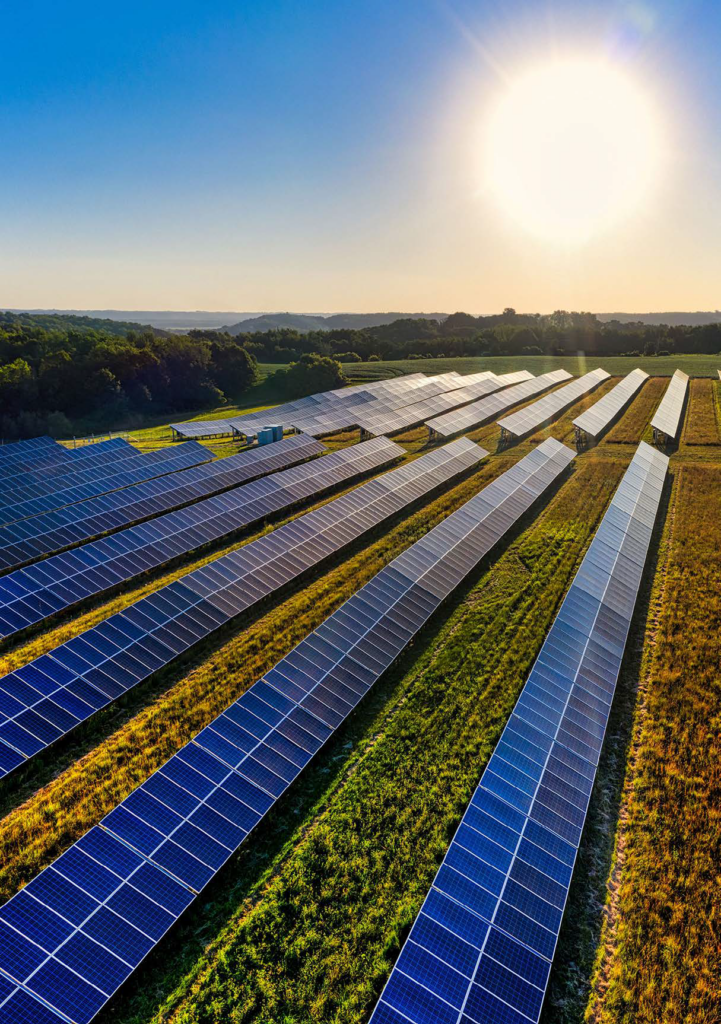
Equipment is spread across large sites and exposed to the weather for years. Fasteners, mounting components and cable-management systems may be modest items individually, but their durability matters across an installation expected to remain in service for 25 years or more.
Stainless steel has a role in these applications where the exposure conditions and maintenance requirements support its use. It should not be assumed that every solar structure requires stainless steel; the choice has to make engineering and commercial sense for the site.
Concentrated solar power adds the demands of elevated temperatures and thermal cycling. Here, material selection for heat-transfer piping, tanks and process equipment must account for the operating temperature and the medium being handled. Corrosion resistance alone is not enough to establish suitability.
Wind energy brings coastal exposure into sharper focus. Salt-laden air and moisture can make corrosion a persistent maintenance concern, particularly where components are difficult to reach. Stainless steel can be used in fasteners, hydraulic equipment and access components, with grade selection reflecting the severity of exposure.
Duplex grades of stainless steel offer a combination of strength and resistance to pitting and crevice corrosion that can be useful in aggressive environments. Even so, the specification needs to address the actual conditions, including locations where moisture and salts may collect. A broad description such as “coastal” is only a starting point.
Hydrogen warrants closer attention
Green hydrogen offers a potentially significant market for stainless steel equipment, but the scale and timing of local demand will depend on projects moving into construction and operation. For fabricators, that distinction is important when assessing where to commit capacity and develop skills.
The production chain brings together several applications, from water treatment and electrolysers to compression, storage and process piping. Each places its own demands on materials. Pressure, temperature, cleanliness and the behaviour of materials in contact with hydrogen all need to be considered.
Stainless steel has an established role in parts of this chain, but there is no single grade suitable for every hydrogen application. In particular, high strength and corrosion resistance do not, on their own, establish that a material is suitable for hydrogen service. Selection requires assessment against the relevant operating conditions and design requirements.
The industrial opportunity extends to the fabrication of vessels, piping and associated equipment. Securing that work locally will require manufacturers to engage with project specifications early and demonstrate that they can meet the necessary quality requirements. An announced project does not automatically translate into orders for South African workshops.
Water remains part of the equation
Water infrastructure deserves attention alongside the more prominent energy technologies. Cooling, treatment and process-water systems are essential to many energy installations, while hydrogen production also requires a dependable supply of suitably treated water.
Pumps, tanks, filters and piping offer familiar applications for stainless steel. In desalination and other aggressive water environments, the choice of grade becomes particularly important. Water chemistry and operating conditions have to guide the specification rather than a general expectation that stainless steel will resist all forms of corrosion.
For the local industry, these applications may offer a more immediate route into energy-related work than some of the emerging technologies. They draw on fabrication capabilities already used in water treatment and industrial processing, although each contract will bring its own technical requirements.
Turning investment into local work
The breadth of these applications gives the stainless steel industry reason to pay attention to energy investment.
It also calls for a more selective view of the market. Maintenance work at an existing plant, components for a solar installation and equipment for a proposed hydrogen facility involve different procurement cycles and levels of certainty.
Local suppliers will need to identify where their capabilities fit, understand the specifications and establish relationships with the companies procuring the equipment. There is a practical case, too, for making lifecycle costs part of those discussions, particularly where maintenance access is difficult or an unplanned shutdown would be expensive.
South Africa’s energy needs create scope for stainless steel to contribute across several technologies. How much of that becomes local manufacturing work will come down to the less glamorous business of project execution, procurement and getting the engineering right.